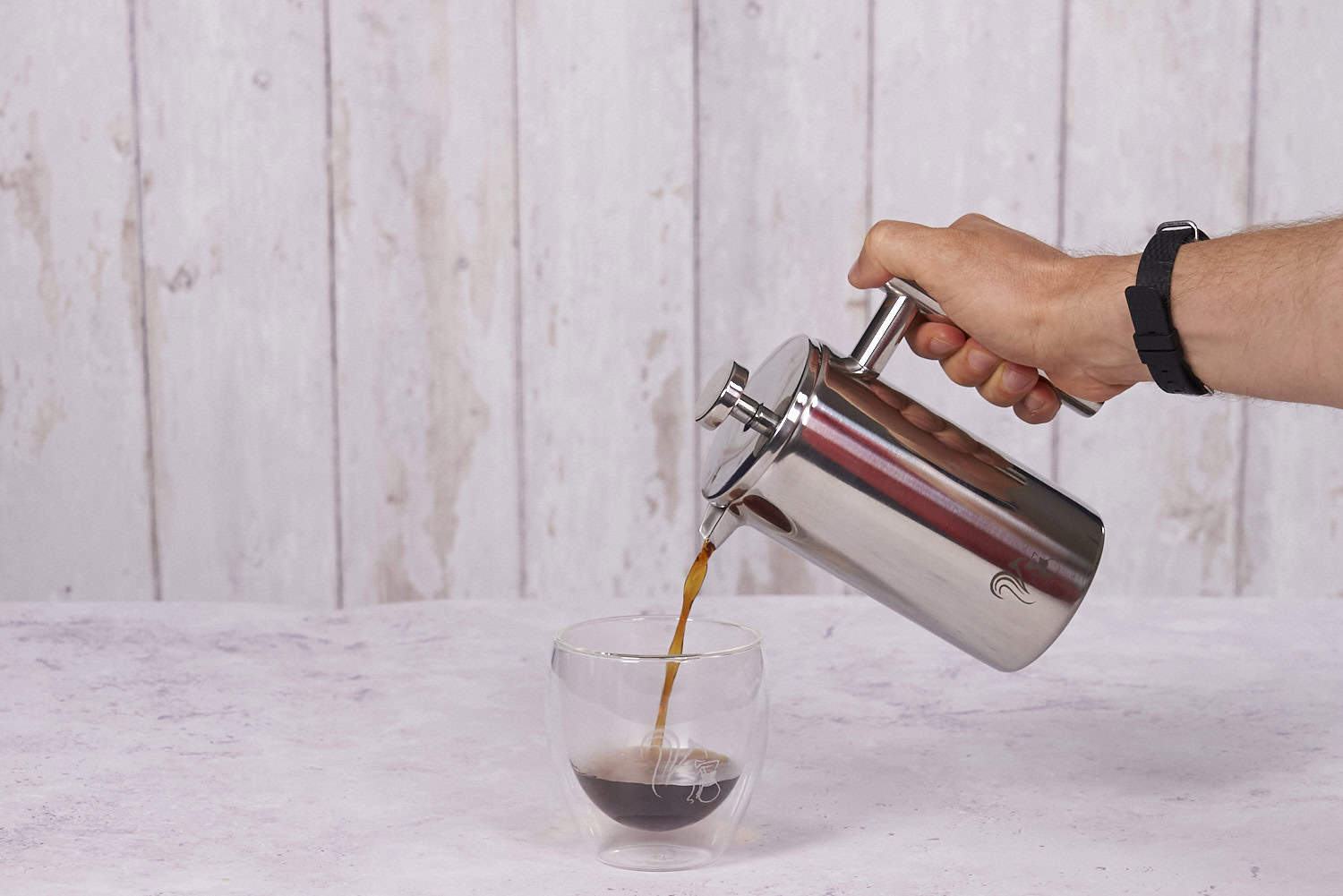



I’ve been noticing a lot of French press vs AeroPress chatter online recently. And seeing as I just can’t seem to help myself, I’ve decided to weigh in.
Of course, regular Coffeeness readers will know that I’m unlikely to pick a favorite. After all, not only am I a diplomatic kind of guy, I also happen to love all things to do with coffee. Well, apart from capsule machines and the exploitation of coffee producers, that is.
Anyway, I’ve written plenty of articles on both the French press and AeroPress, and I never get tired of promoting the joys of manual brewing. So, let’s jump right in!
Table of Contents
French Press vs AeroPress Overview
As I just mentioned, there’s something incredibly rewarding about manual coffee brewing. Whether you like to prepare pour-over, Chemex or stovetop espresso, making coffee by hand is always a lot of fun. Plus, it can be a lot easier than navigating a complicated fully automatic coffee maker or home espresso machine.
Both the AeroPress and French press employ what’s known as the full immersion method, wherein coffee grounds are steeped in hot water before being filtered. With that said, there are significant differences between the two devices.
The most important difference to bear in mind is that the AeroPress coffee maker also uses pressure during the extraction process. And while the French press is simple and straightforward, the AeroPress encourages experimentation.
I’ll get into the similarities and differences between the two brewers a little later. However, I should remind you that getting the best results from either coffee maker involves a couple of non-negotiables. For starters, you’ll need a good burr coffee grinder. In my experience, a budget-friendly model like the OXO Burr Coffee Grinder will be better suited to the AeroPress. And even though cheaper grinders usually struggle at the coarser end of the grind size spectrum, I’ve found that the Capresso Infinity Plus delivers excellent results for French press coffee.
Another essential purchase is a good coffee scale. Trust me, if you want consistent and repeatable results when you brew coffee, invest in a scale and weigh out your beans every time. You won’t have to spend a lot of money and you’ll be glad you made the investment.
What Is a French Press?

I wouldn’t be surprised to learn that most of you have a French press hanging out in your kitchen. After all, this is one of the most popular coffee brewing methods there is. The French press comes in all different sizes and it isn’t uncommon to see metal models these days. Still, for me, the classic Bodum French press is where it’s at.
The Bodum consists of a metal frame that holds a borosilicate glass beaker. There’s also a plunger, which is a long metal rod with a knob on the top and a stainless steel mesh filter assembly at the bottom. The only problem is that the filter assembly requires thorough cleaning on a regular basis. And as well as being fiddly, the mesh can become damaged over time.
See Also: Best French Press
Using a French Press
As it happens, the French press is one of the easiest and most forgiving ways to make coffee. It’s literally a case of dumping in ground coffee, adding water then plunging after letting the coffee grounds sit for a few minutes. Of course, if you want to do things properly, you should measure your beans with a coffee scale, grind them correctly and use water that’s been off the boil for around a minute.
I’ve found that pouring halfway, letting the coffee bloom for around 30 seconds and then topping it off helps me achieve a more well-rounded brew. I then plunge a couple of inches before setting a timer for three minutes. Finally, I’ll push the plunger all the way down before transferring the contents to a thermal jug. That’ll prevent over-extraction and keep my coffee nice and hot.
Although French press is a very forgiving brew method, you will have to use a sufficiently coarse grind size. And the resulting coffee won’t be to everyone’s taste. Seeing as the mesh French press filter allows some amount of grounds to pass through, as well as coffee oils, the brew will have a heavy mouthfeel, and you’ll likely find some sediment in the bottom of your cup. While I rather enjoy this, coffee snobs dismiss the French press as an amateur device that produces coffee that’s lacking clarity and complexity.
French Press Advantages
Very forgiving and easy to use
Many different sizes available
Very affordable
Makes full-bodied and rich coffee
Makes multiple cups
French Press Disadvantages
Glass carafes can break easily
Coffee can taste “muddy”
Not much room for experimentation
Cleaning can be a drag
What Is an AeroPress?

Just like the French press, the AeroPress is a full-immersion coffee brewer. With that said, the AeroPress produces a radically different style of coffee. This has a lot to do with the fact that the AeroPress uses special paper filters, which prevent oils and undesirable bitter compounds from passing into your brew.
What’s more, you’ll need to use a much finer grind size with an AeroPress, and this means each granule has a much larger surface area.
The AeroPress features a unique design that sets it apart from all other coffee brewing devices. Although it’s an immersion brewer, there’s also a piston that creates a vacuum as you’re pressing the coffee. In other words, the AeroPress is somewhat of a hybrid device that employs pressure in a similar way to an espresso machine. And to top it all off, this nifty coffee brewer is compact and basically indestructible, making it an ideal travel companion.
See Also: AeroPress Review
Using an AeroPress
What draws coffee enthusiasts to the AeroPress is its incredible versatility. In essence, there are two main ways to use the thing:
The standard method: Fill the chamber with water and ground coffee, stir, attach the filter cap then place the AeroPress on a cup and press down on the plunger to extract your brew.
The Inverted method: Place the device upside down on top of the plunger, add water and coffee, wait while the coffee steeps then flip the AeroPress over before plunging.
In both cases, the resulting coffee is lighter, cleaner and more nuanced than what you’ll get from a French press. However, you’ll need to experiment with your dose, grind size and steep times.
With that said, the AeroPress has become a darling of the specialty coffee world, and you’ll find hundreds of recipes online. In fact, there are even AeroPress brewing competitions these days, where barista champions produce incredibly complex espresso-like brews.
AeroPress Advantages
Durable and travel-friendly
Versatile
Very inexpensive
Produces clean and complex coffee
Great for single cup servings
AeroPress Disadvantages
Can be messy
Requires special paper filters
Steeper learning curve
Not great for multiple cups
French Press vs AeroPress: Comparing Features
Now that we’re fully immersed (pun very much intended) in the French press vs AeroPress debate, let’s put these two brewers in a head-to-head battle. Keep reading to learn more about how they compare in terms of their most notable features.
Price
In terms of how much you’ll spend, neither the French press nor the AeroPress is going to break the bank. In fact, either device represents one of the most affordable ways to prepare quality coffee at home.
The AeroPress Original currently costs $34.96 on Amazon, and although you’ll need to buy AeroPress filters, they cost just $17.95 for a pack of 700. Incidentally, the manufacturer has flooded the market with variations on the AeroPress theme, including larger models and even a premium glass version. Personally, I’d stick with the original.
As for the French press, my beloved 34-ounce Bodum Chambord will set you back $39.99. Again, this isn’t expensive in the least, and you won’t need to buy extra filters.
Recently, I’ve reviewed more boutique models, many of which are very impressive. Check out my Fellow French press review if you’re looking for the best of the best. Still, I have to say that you aren’t going to notice radically different cup results from a more expensive French press. It’ll just look prettier and break less easily.
Design and Durability
As you now know, the AeroPress is basically bomb-proof thanks to its sturdy BPA-free plastic construction. Trust me, I’ve dropped mine on multiple occasions and it’s still going strong.
On the other hand, a French press with a glass carafe is a more delicate proposition. And while it’s easy to find a replacement beaker, you still need to be careful when you’re using the thing. So, if you’re looking for a travel-friendly French press or you suffer from bouts of clumsiness, I’d recommend spending a little more on a plastic or stainless steel model.
Ease of Use & Versatility
I’m hesitant to play favorites, but the French press has to come out on top when it comes to ease of use. Seriously, if you like the idea of being able to dump coffee grounds into a pot without worrying about brew ratios, you’ll be onto a winner with the French press.
What’s more, this brew method is very forgiving in terms of grind size as long as it’s sufficiently coarse. In other words, you aren’t going to have to “dial in” to whip up a pot of coffee.
The AeroPress definitely involves a steeper learning curve if you want drinkable results. This device demands more precision and concentration on the part of the user, which could end up being challenging first thing in the morning. Plus, the AeroPress is a single-serve coffee maker, so if there’s more than one coffee drinker in dire need of their caffeine fix, you’ll have to go through the whole process again.
With that said, I’ve found that you’re able to prepare a more concentrated brew and make an AeroPress americano. So there is that option available.
Coffee Taste
It’s impossible to pick a winner when considering how the coffee tastes from each brewer. After all, plenty of folks will relish the full-bodied, robust and downright comforting coffee that only a French press can produce. Heck, I even know people that enjoy the silty residue at the bottom of the cup!
As for the AeroPress, its versatility means you have way more control over your coffee’s taste and body. Personally, I love brewing single origin coffee with my AeroPress, seeing as I can tease out all the complex and subtle elements. All in all, AeroPress coffee is lighter, fresher and displays more depth than French press coffee.
Portability

One of my favorite things about the AeroPress is its portability. In fact, I seldom take a trip without throwing the thing in my backpack. I mean, you just never know what the coffee situation is going to be like where you’re going! Best of all, I can fit my Porlex Mini hand grinder in the AeroPress chamber, so I can grind my best coffee beans fresh to boot.
I wouldn’t say that the French press is necessarily the best camping coffee maker out there, but some of the more high-end models are pretty darn tough. Still, the main issue with using a French press for travel is the cleaning process. This requires a lot of water and can get rather messy. And with that in mind, I’d have to conclude that the AeroPress is a superior travel companion.
French Press vs AeroPress Comparison Chart
| French Press | AeroPress Original | |
|---|---|---|
| Price | $15-$100+ | $35 |
| Materials | Glass, metal, ceramic | BPA-free plastic |
| Capacity | 15-35 oz / 0.4-1.0 l | 10 oz / 300 ml |
| Brew time | 4-5 minutes | 1-3 minutes |
| Grind size | Coarse | Medium-fine |
| Coffee taste | Bold, full-bodied, complex | Smooth, full-bodied, low acidity |
Verdict: Which Brew Method Is Better?
You didn’t really expect that I’d pick a side in the French press vs AeroPress debate did you? I mean, both brewers are cheap, effective and relatively easy to use. With that in mind, I encourage you to follow my lead and keep one of each in your kitchen.
The enduring French press is ideal for lazy Sunday mornings, especially if you’ve got company. It’s easy to use, very forgiving and the majority of people enjoy its rich, full-bodied coffee.
On the other hand, the AeroPress will be there for when you’re feeling a little adventurous. Pull out your best single origin beans and revel in how the AeroPress highlights the inherent qualities of your natural process Ethiopian or fully washed Honduras micro-lot.
Which side are you on? I look forward to hearing all about it. So, leave a comment below and let’s keep the AeroPress vs French press debate going!