




Even though I am a big fan of manual coffee brewing methods, I don’t mind if machines take over a few steps from time to time – when it comes to milk foam, for example. However, there’s a strong case to be made for devices that allow you to froth milk yourself.
In my guide to the best milk frothers, the Bodum Latteo easily overshadows all other devices in terms of its price-performance ratio. Still, having tested the Bialetti Tutto Crema, I can tell you that it certainly competes as a manual milk frother.
As it happens, the little Italian is a pretty good investment and even manages to break down some of the limitations of the Latteo. Although it has a few quirks of its own, it also confirms my overall assessment:
I’m a fan of manual milk frothers! Keep reading below to find out why.
Solid manual milk frother
Bialetti Tuttocrema Milk Frother
Almost as good as the Bodum Latteo!
Easy to use
Fast heating
Compact design
Good value
Limited capacity

| Bialetti Tuttocrema Milk Frother | |
| Current price on Amazon | |
|---|---|
| All specifications | |
Table of Contents
Bialetti Tuttocrema Overview
Bialetti is certainly familiar to every coffee fan. After all, the Italian manufacturer has been producing its Bialetti Moka Express for years, and the brand name is practically synonymous with the stovetop espresso maker.
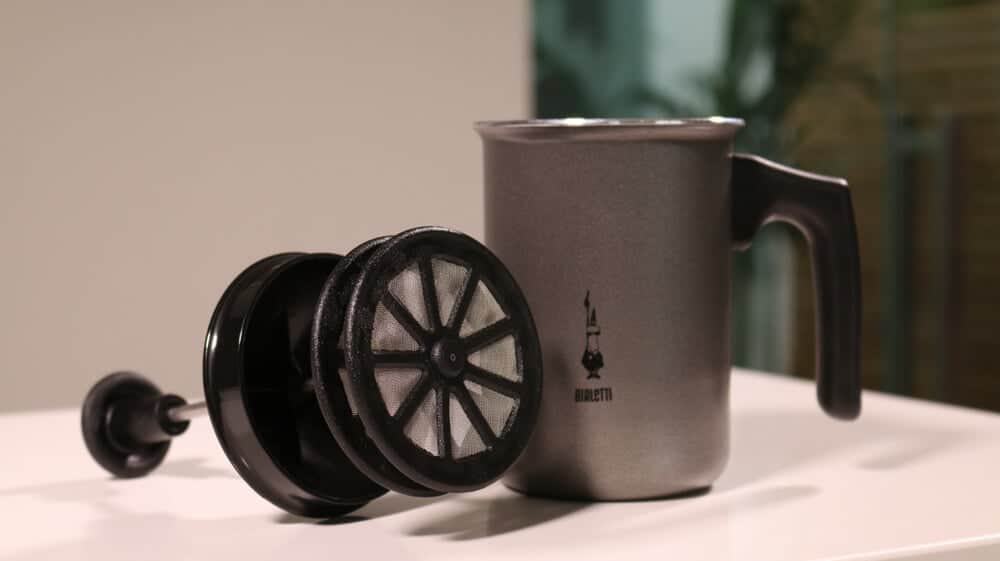
The classic Bialetti look was also the inspiration for the design of the Tuttocrema milk frother. The device consists of an insulated and coated aluminum pot with a handle, and is closed by a lid with a movable double mesh sieve.
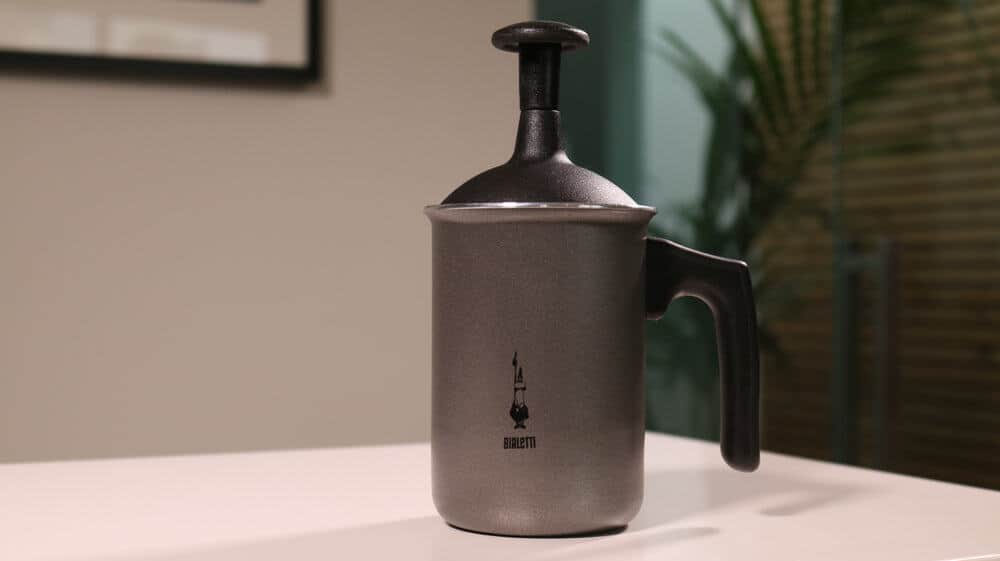
In addition, the Tuttocrema has a typical “pot base,” so you can heat milk in the frother directly on the stove. At least in theory.
While the Latteo’s visual similarity to a French press is quite obvious, this association certainly doesn’t arise with the Bialetti frother. Rather, it immediately reminds me of a milk pitcher.
Right now, the Bialetti Tuttocrema Milk Frother is available on Amazon for $N/A, which is quite a bit more than the $19.99 you’ll spend on the Bodum Latteo Glass Milk Frother. Then again, you won’t have to worry about picking up glass shards if you drop the thing.
The Bialetti’s aluminum construction has one main drawback: you definitely won’t know what you’re doing when pumping (aka “frothing”). We’ll come back to that later.
Overall, I find the Bialetti Tuttocrema just as visually appealing as the Latteo, and perhaps even a little more reassuring. What’s more, the double sieve could ensure that the milk foam is ready even faster than in the Latteo. This is because, mathematically speaking, a double sieve results in greater foaming performance.
First Steps
Thorough pre-cleaning is essential with the Bialetti, because at least my Tottocrema was quite dirty inside – something was stuck to the coating. However, it comes off quickly, and then you’re ready to go.
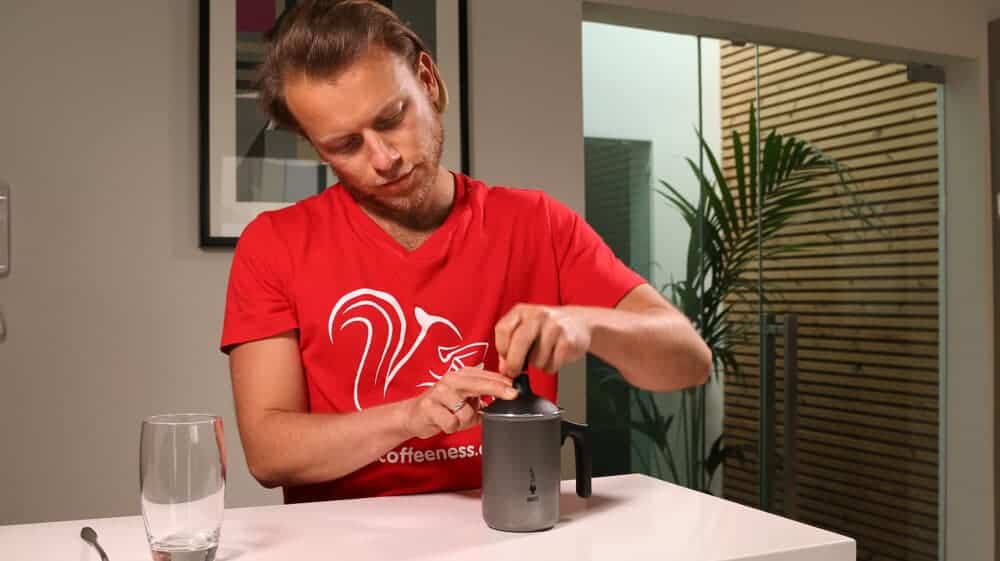
According to the operating instructions, you should fill a third of the container with milk, place it on the stove without the lid, heat the milk, remove it from the heat and then froth the milk with gentle but firm pumps.
That’s all well and good, but the milk frother doesn’t have any markings inside. So, I just eyeballed it as I poured in my full-fat milk.
Beforehand, I did a few dry pumping exercises and found that the Bialetti frother is much more stable than the Latteo. Its shape makes it easier to grip and you can hold the lid in place with one finger.
By the way, I can only laugh about a jug capacity of supposedly “3 cups”. If you stick to the operating instructions (and you should!), you’ll end up with enough foam for one (small) cup.
In other words, the filling quantity is just enough for a typical French Picardie wine glass with a capacity of around 5.5 ounces (160 milliliters). The “3 cups” therefore refer to the amount of milk you can heat.
The Bialetti Tuttocrema in Use
Obviously, the Bodum Latteo isn’t suitable for stovetop use seeing as it’s made of glass. However, the Bialetti Tuttocrema’s aluminum construction means you can heat milk on a gas, electric or glass ceramic hob. If you have an induction cooktop, things will look a little more complicated. Essentially, you’ll have to heat your milk separately, which I did in a pot. Here are a few things to remember:
The optimal milk temperature is slightly below 160 degrees Fahrenheit (70 degrees Celsius). Look for white, fairly transparent steam.
Don’t forget to stir!
Then carefully pour it back into the Bialetti.
By the way, if you want to be able to heat milk in the Tuttocrema on an induction surface, the manufacturer sells its own induction adapter plate.
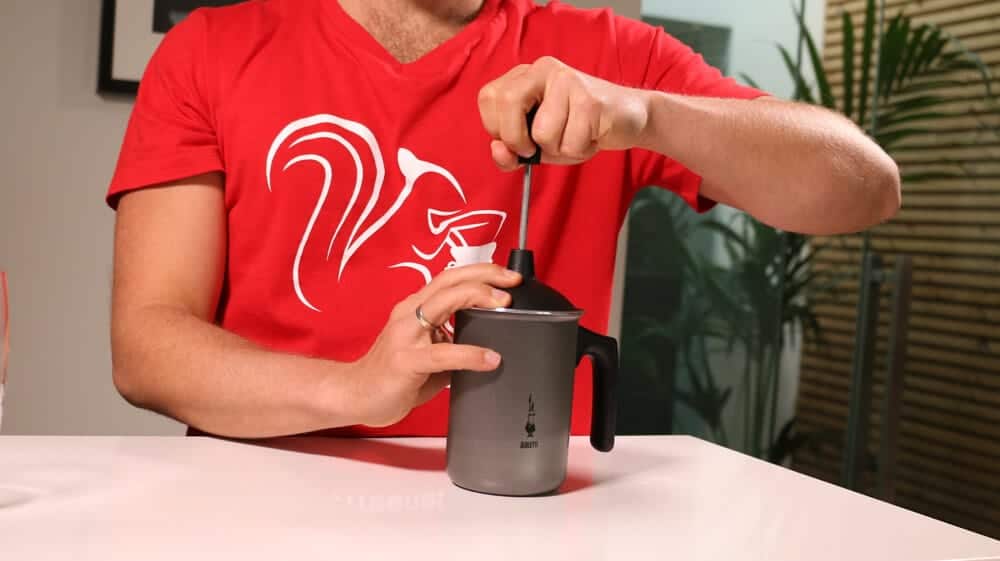
While Bodum preferred to keep quiet on the subject of “necessary pump strokes,” Bialetti confidently states that “The lid … allows you to obtain a soft crema in 10 seconds.”
I don’t know who was in charge of translating from Italian, but I kind of like the idea of “milk crema.” Besides, it sums up what we actually want: creamy milk rather than bubbly froth.
In any case, I set myself a time limit of ten seconds and pumped carefully but firmly. Whatever that means. I can tell you this much:
The milk only spills out very slightly from all openings.
You have to hold everything tightly and be careful not to touch the very hot jug!
However, its compact size and ergonomic handle make it really easy for you to keep the Tuttocrema stable.
Bialetti Tuttocrema Milk Foam: My Observations
With the Latteo, you can easily check whether the milk volume has doubled. Of course, this doesn’t work with the aluminum Bialetti. And that bothers me immensely. Because in my opinion, the recommended 10 seconds just isn’t enough.
Because if you pump too slowly, too irregularly or however else, a lot of milk will remain un-foamed in the jug. In other words: pump several times, check briefly, pump again if necessary and forget about counting.
After pumping a little more, I compared the milk foam with that of the Bodum Latteo:
The Bialetti foam has a few fairly noticeable air bubbles, but you can quickly get rid of them by tapping and swirling the easy-to-handle pot.
It’s just as creamy, but not quite as elegant and perfectly smooth as Latteo foam.
The milk-foam ratio is probably even more difficult to get right than with a Latteo, and at least in the beginning, it tends to be unfavorable. But “manual” also means that you can learn as you go.
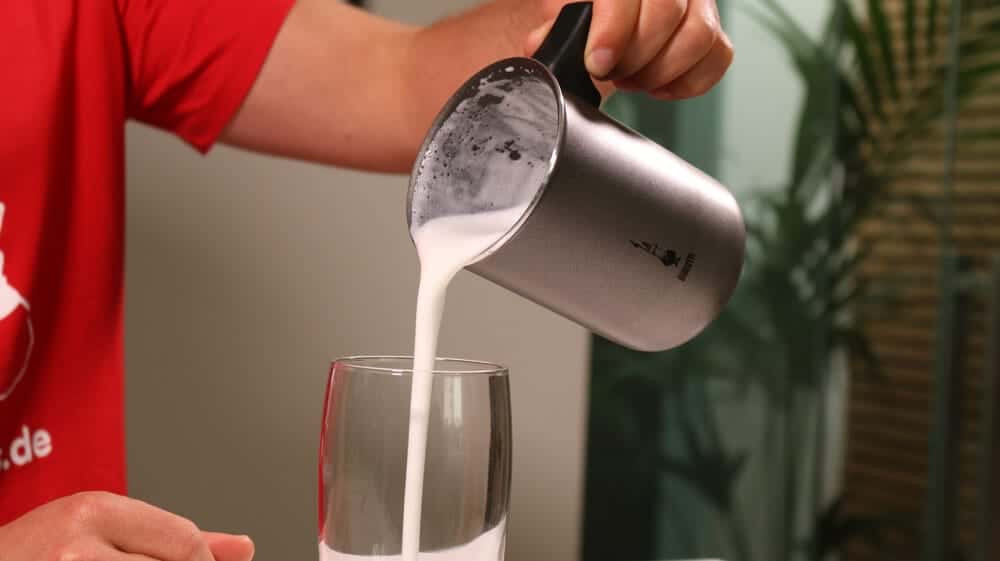
Basically, however, the foam is just as good, if not better, than that produced by automatic machines such as the Nespresso Aeroccino 3 or the Keurig Standalone Frother – because the consistency is much closer to what I consider perfect milk foam. Only the Maestri House Milk Frother does it even better at the touch of a button.
I would rank the milk foam produced by the Bialetti above almost all automatic milk frothers, but definitely behind the Maestri House in second place and the Bodum Latteo in first place.
What Else Can the Manual Bialetti Tuttocrema Milk Frother Do?
While I confidently recommend the Bodum Latteo to you as a device that can be used to mix, heat and froth hot chocolate, chai and other beverages, I would advise against doing so with the Bialetti.
This is because the coated aluminum isn’t compatible with the sugar in powdered drinks. So, there’s a high risk that it will caramelize, burn and create an insoluble crust at the bottom of the jug.
On the other hand, there’s nothing wrong with using plant-based milk. You simply have to try out which varieties produce the foam you love. Personally, I’d say the best non-dairy milk for frothing is oat milk, with soy milk coming in a close second.
Bialetti Tuttocrema Cleaning
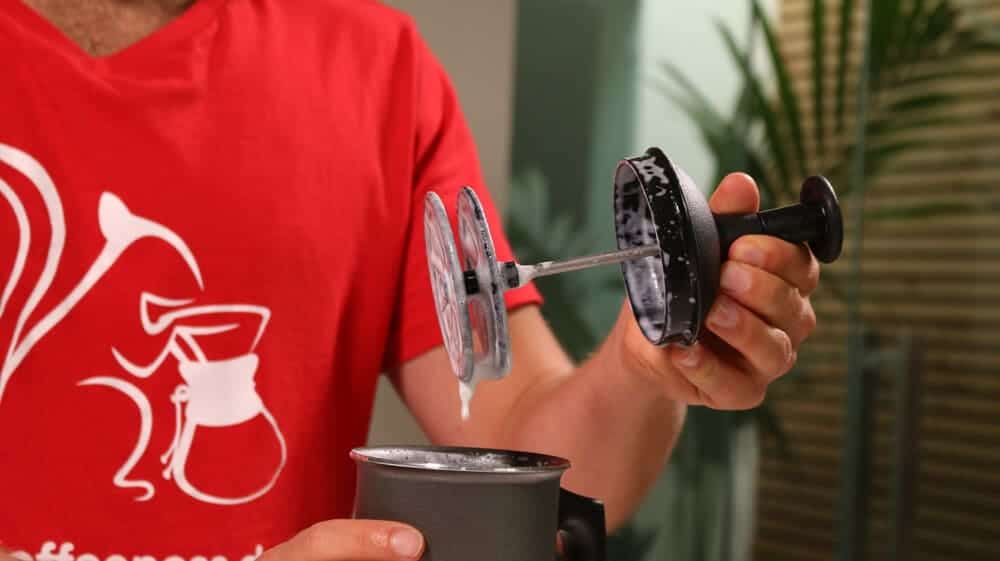
As with the Latteo, all parts of the Bialetti can be placed in the dishwasher without exception, despite their coating. If you don’t have a dishwasher, you can clean the pot and mesh sieve thoroughly by hand. And although it has a double sieve design, it’s fairly easy to reach all the nooks and crannies.
Verdict: Bialetti Tuttocrema Review
Solid manual milk frother
Bialetti Tuttocrema Milk Frother
Almost as good as the Bodum Latteo!
Easy to use
Fast heating
Compact design
Good value
Limited capacity
| Bialetti Tuttocrema Milk Frother | |
| Current price on Amazon | |
|---|---|
| All specifications | |
Let’s return to my initial statement about me being a real fan of manual milk frothers. Honestly, this remains the case after testing the Bialetti, although it ultimately cannot quite hold a candle to the Bodum Latteo.
However, both devices are extremely affordable, easy to use and produce perfect or very good milk foam that you can also adjust to your taste. Although you have to do a lot yourself, the process is straightforward and fairly painless.
Let’s take another quick look at the pros of the Bialetti Tutto Crema:
Easy to use
Stovetop compatible
Easy to handle (with a little care)
Makes very good milk foam
Fast heating
Compact
Affordable price tagAffordable price tag
Easy to clean
Only the amount of foam in the 3-cup version is clearly insufficient, and it really annoys me that I can’t see how the milk foam is progressing.
The Latteo from Bodum does some things a lot better, but it’s way more fragile. Plus, you can only use it in the microwave if you want to heat milk in the pot itself.
In any case, I’m giving the Bialetti Tuttocrema a high score seeing as it easily outperforms most automatic milk frothers. And let’s not forget that it looks pretty cool too!
What’s your favorite manual milk frother? Is there a model I should test in the Coffeeness kitchen? Let me know in the comments section!